
The EUNIS Enterprise Architecture (EA) SIG is built on sharing knowledge and learning from one another. In this profile, we speak with Johan Flid Fridell, Enterprise Architect at KTH Royal Institute of Technology, about his institution’s experience adopting Higher Education Reference Models (HERM), the lessons learned along the way, and why he believes the combination of a shared framework and an active community is what makes HERM such a valuable resource for higher education.
Could you briefly introduce yourself, your role, and your institution?
I am Johan Flid Fridell, one of two Enterprise Architects at KTH Royal Institute of Technology in Stockholm, Sweden.
Although I am part of the IT department, much of my work takes place at the intersection of business and technology. I support KTH’s five digitalisation portfolios and work closely with portfolio leadership, domain architects, and business stakeholders to strengthen strategic planning, enterprise architecture, and organisational change.
My primary focus is business architecture and capability-based planning, helping the university understand and develop the capabilities required to support education, research, and administrative services.
How did you first become involved with HERM?
When I stepped into the role of Enterprise Architect, one of my key responsibilities was introducing business capabilities into our enterprise architecture practice. Rather than starting from scratch, a fellow architect suggested we explore HERM as a mature framework developed specifically for higher education.
At the same time, HERM, particularly the Business Reference Model (BRM), was already being discussed within a national architecture working group under ITCF/ATI. That gave us two major advantages: access to a well-developed capability model and a community of practitioners already exploring how to apply it.
Looking back, that combination accelerated our learning significantly. Instead of developing our own framework, we could focus on understanding, adapting, and applying one that had already been refined by universities facing similar challenges.
How has HERM been used within your institution?
Our initial objective was simple: introduce business capabilities into our enterprise architecture toolbox.
We adopted the BRM early and integrated it into our architecture models and planning processes. The transition was surprisingly smooth, and stakeholders responded positively because capabilities provide an intuitive way to discuss what the university does rather than how it is organised.
More recently, we have started using other HERM artefacts, including the Technology Reference Model (TRM), to create a more consistent way of discussing technology across portfolios.
The greatest benefit has been speed and consistency. By leveraging a mature reference model, we can focus on the areas where local context matters most rather than reinventing foundational concepts.
Another important benefit is interoperability. Because many institutions use the same framework, HERM creates a shared language that makes collaboration and benchmarking across universities much easier.
What were some of the biggest lessons learned during implementation?
Implementation requires two things: understanding the model well enough to use it confidently yourself, and being able to explain it in a way that makes sense to others.
My first lesson was simple: study the model before trying to improve it.
Early on, I thought I had found gaps in the capability map and started proposing new capabilities. Later, I realised most of those concepts already existed; I simply hadn’t fully understood the framework.
The biggest challenge has been stakeholder perception. Almost every domain expert feels their area is either underrepresented or described at too high a level. What has worked well is explaining that a capability map is not about organisational importance or resource allocation. It is a strategic representation of what the institution needs to be able to do. Once stakeholders understand that distinction, discussions become much more productive.
My advice is to preserve the common model at the higher levels and make local adaptations at lower levels of detail. A model is only useful if it is understood and accepted by the organisation.
What impact has HERM had on your institution?
The most immediate impact has been within the IT department and our enterprise architecture practice. HERM has given us a common way of describing the university and its operations, independent of organisational structures.
Our next step is integrating business capabilities into strategic portfolio management. We have already started this journey in two of our five portfolios and are gradually expanding it across the institution.
Our ambition is for capabilities to connect strategic priorities, portfolio planning, investment decisions, and operational execution. In that sense, I believe the greatest impact of HERM is still ahead of us.
You were also involved in translating HERM into Swedish. What was that experience like?
Yes. I was heavily involved in the first Swedish translation of HERM 3.1.0 and later chaired the working group responsible for updating the Swedish BRM for version 3.2.0.
Translation turned out to be much more than a linguistic exercise. It forced us to examine the meaning of every capability and discuss how it should be interpreted within the Swedish higher education context.
For the latest version, we chose to stay very close to the English source material. Since the translation is also used by institutions in Finland, maintaining a common reference point was considered more valuable than extensive localisation.
Perhaps the greatest benefit was the dialogue itself. Discussing terminology and capabilities with architects from other universities gave me a much deeper understanding not only of the model but also of the diversity that exists across higher education.
Can you share an example of HERM creating value in practice?
In one of our portfolios, capability mapping helped us identify a significant gap in central support.
The capability map showed that several important capabilities depended largely on local initiatives rather than coordinated university-wide support. This wasn’t because people weren’t doing good work—valuable work was already happening, but because those efforts lacked a coherent institutional support structure.
That insight became a constructive starting point for discussions about future investments and how the portfolio could better support the university’s long-term needs.
What advice would you give to institutions considering HERM?
My first piece of advice is simple: talk to another university that has already done it.
The practical lessons learned from peers are invaluable and can significantly shorten the learning curve.
Learn from institutions already using HERM, evaluate whether it meets your needs better than alternative frameworks, and consider the long-term value of joining a community that continually develops and improves the model.
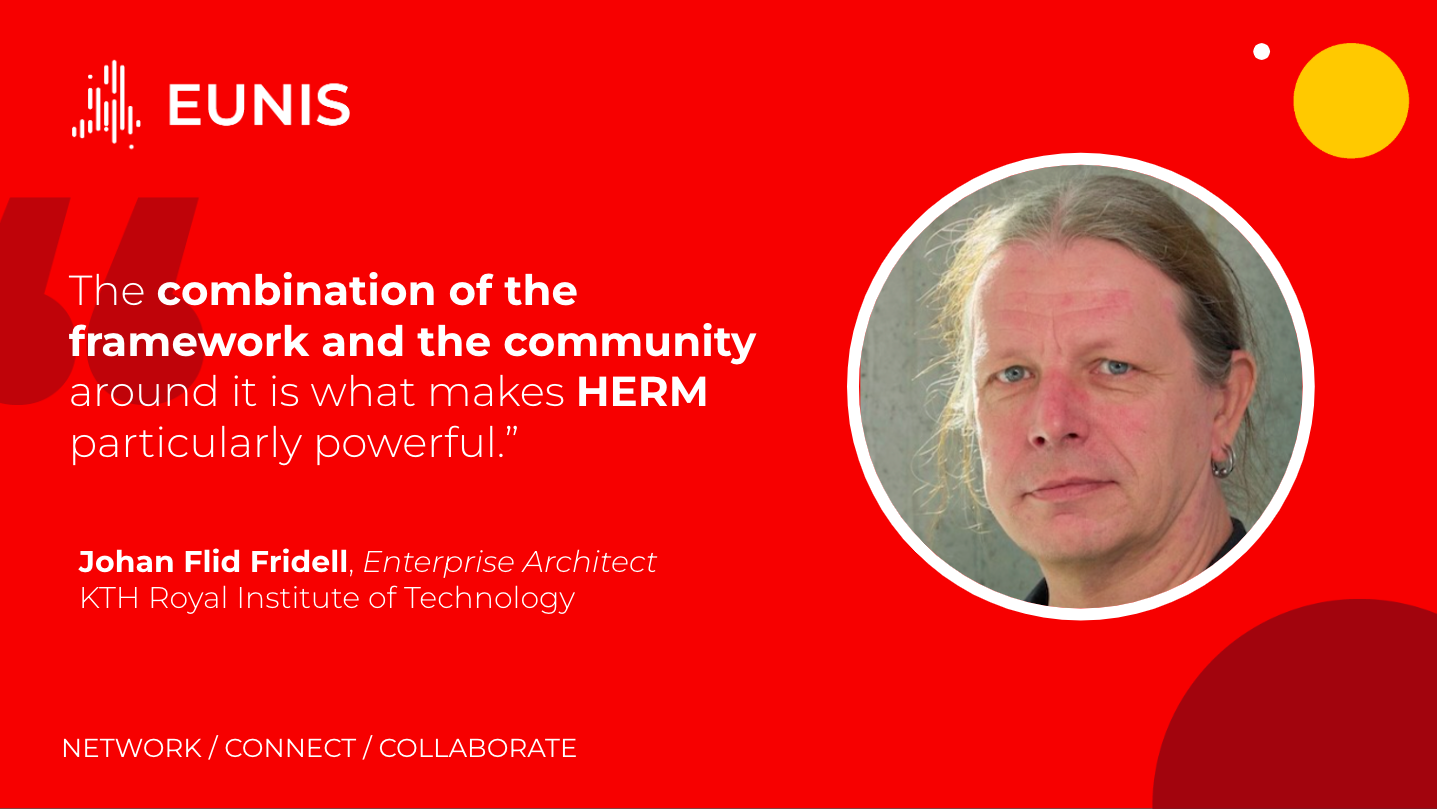
If you decide to adopt HERM, engage actively with networks such as the EUNIS EA SIG. In my experience, the combination of the framework and the community around it is what makes HERM particularly powerful.
Personally, I could never have made this journey as quickly without the support of colleagues both nationally and through the EUNIS EA SIG community.
Finally, in one sentence: why does HERM matter for higher education today?
HERM provides higher education institutions with a shared language for understanding, planning, and evolving increasingly complex organisations.
