
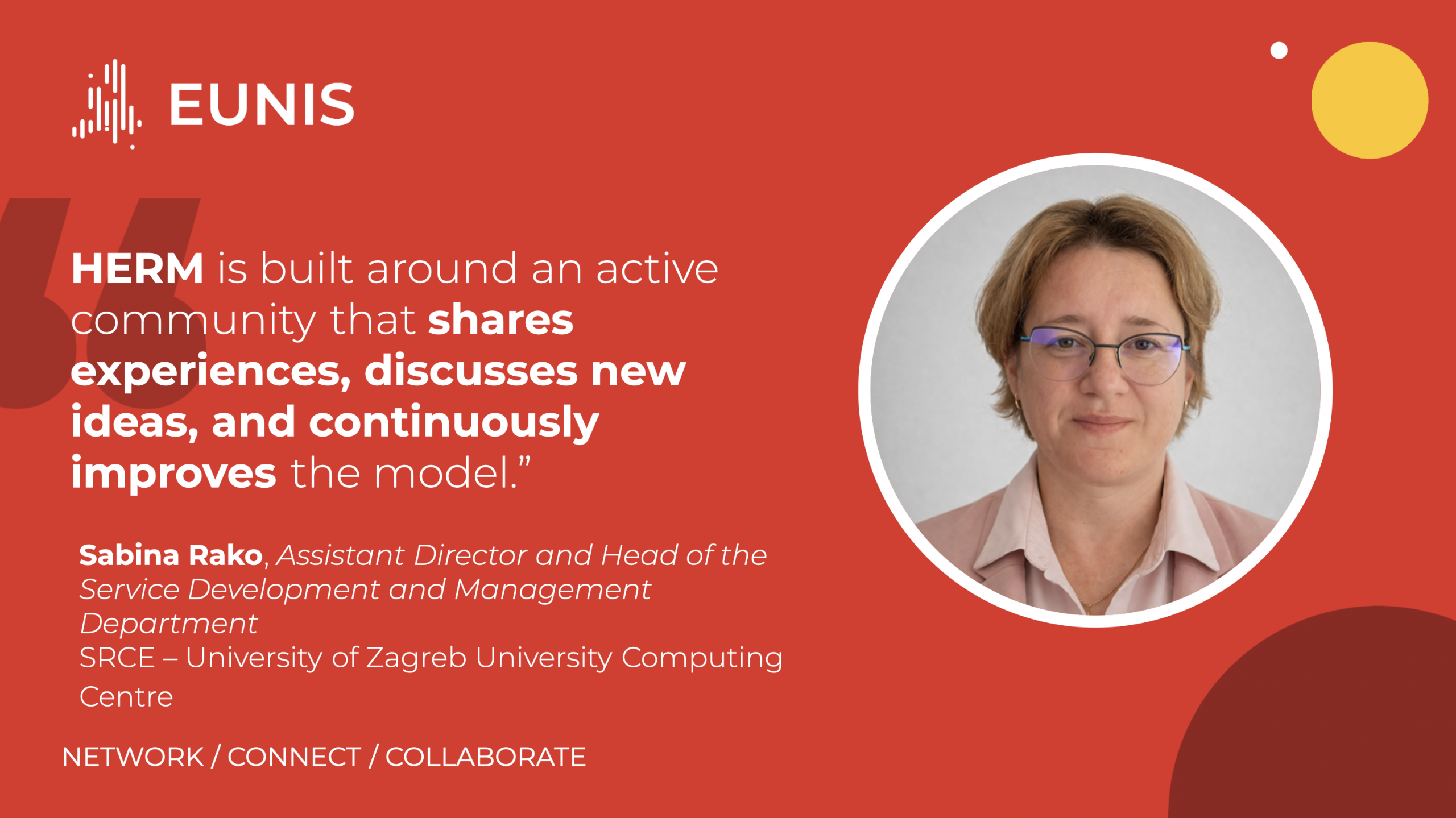
The EUNIS Enterprise Architecture (EA) SIG is driven by collaboration, knowledge sharing, and the continuous evolution of Higher Education Reference Models (HERM) through its community. In this profile, we speak with Sabina Rako, Assistant Director and Head of the Service Development and Management Department at SRCE – University of Zagreb University Computing Centre, about how she first discovered HERM, her work promoting and translating the framework in Croatia, and why she believes the strength of HERM lies not only in the model itself, but in the community that continues to develop and apply it across European higher education. We also look ahead to EUNIS EA Week 2026, which SRCE will host in Zagreb, bringing enterprise architecture professionals together to exchange experiences, strengthen collaboration, and help shape the future of HERM.
Could you briefly introduce yourself, your role, and your institution?
Hello, my name is Sabina Rako. I am the Assistant Director and Head of the Service Development and Management Department at SRCE – University of Zagreb University Computing Centre, where I contribute to the development and management of digital services that support higher education and research.
Over more than 20 years in higher education IT, one of the most rewarding aspects of my career has been collaborating with colleagues at SRCE and partners across the higher education community to develop digital services that support teaching, research, and the everyday work of universities.
I am proud to be part of SRCE, Croatia’s national e-infrastructure institution for higher education and research. We develop and operate the digital infrastructure and services that universities and research institutions rely on every day—from digital learning platforms and identity management to cloud services, advanced computing, and open science. Our mission is to provide reliable and sustainable digital infrastructure that supports higher education and research while connecting the Croatian academic community to the European and global research and education ecosystem.
How did you first become involved with HERM?
My first encounter with HERM was at the EUNIS Conference in Trondheim in 2019, during a workshop organised by the EUNIS Enterprise Architecture SIG. I remember thinking that I had finally found a structured way to answer a question I had been asking for years: How can we better understand and manage the complexity of higher education institutions in a practical way?
Since SRCE develops digital services for higher education institutions, HERM immediately stood out as a valuable reference model. It provided a common language for discussing institutional needs and business capabilities, helping us better understand how our services can support universities’ strategic goals.
Inspired by that workshop, I joined the EUNIS Enterprise Architecture SIG, led by Patrik Maltusch and Esa Suominen. Since then, I have had the opportunity to work closely with them and many colleagues across Europe. Together with colleagues from SRCE, I have organised HERM workshops and community activities to encourage Croatian higher education institutions to use HERM in their everyday work. I have also applied HERM in my academic research, which has given me another perspective on its value as a model for understanding higher education institutions.
Collaboration within the EUNIS Enterprise Architecture community continues to grow. After successful EA Weeks in Finland, Denmark, and Germany, we are proud that SRCE will host EUNIS EA Week 2026 in Zagreb. It will be an excellent opportunity to bring the community together, exchange experiences, and continue advancing HERM and enterprise architecture across European higher education.
You were involved in translating HERM into Croatian. What was that experience like?
Together with my colleagues, I have been involved in translating HERM into Croatian and adapting it to our national context. Having a shared terminology in the national language makes it much easier for institutions to discuss processes, enterprise architecture, and digital transformation.
The translation process is much more than translating words. It requires discussing the meaning behind each term and finding expressions that fit both the HERM framework and the local higher education environment. Thanks to the support of the EUNIS Enterprise Architecture SIG and its translation guidelines, the process has been collaborative, structured, and very rewarding.
One of the most interesting aspects has been learning how colleagues from different countries interpret the same concepts and adapt them to their own educational systems. It reminds us that while our institutions may differ, many of the challenges we face are shared.
What would you say to colleagues who are considering HERM for the first time?
My advice is simple: start by exploring HERM and thinking about how it can help address the challenges your institution faces. Begin with a small use case that matters to your institution, learn from the experience, and build gradually.
Connect with your national higher education enterprise architecture community or join the EUNIS Enterprise Architecture SIG. The opportunity to exchange ideas, ask questions, and learn from others is one of the most effective ways to support the adoption of HERM and discover how colleagues are applying it in practice.
Most importantly, HERM is built around an active community that shares experiences, discusses new ideas, and continuously improves the model.
